
May 3 is World Press Freedom Day.
World Press Freedom Day was proclaimed by the UN General Assembly in 1993 following a Recommendation adopted at the twenty-sixth session of UNESCO’s General Conference in 1991 commemorating the Windhoek Declaration for a free and pluralistic press marked every year to celebrate the fundamental principles of press freedom, evaluate its state worldwide, defend media independence, and pay tribute to journalists who have lost their lives in the line of duty.
Every year on 3 May the world celebrates the fundamental principles of press freedom, to evaluate press freedom around the world, to defend the media from attacks on their independence and to pay tribute to journalists who have lost their lives in the exercise of their profession.
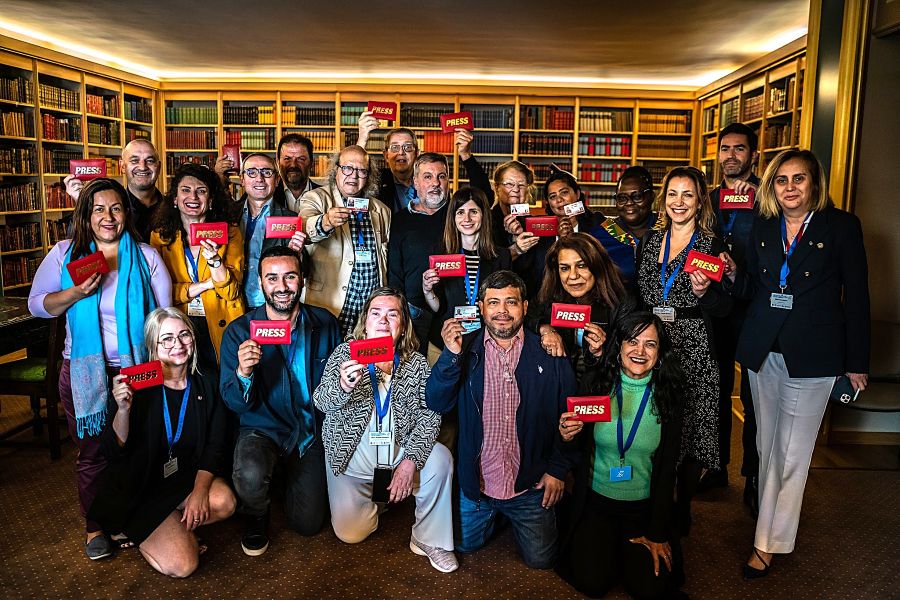
the International Federation of Journalists (IFJ) that represents more than 600,000 journalists and media professionals worldwide, through 187 unions and associations in more than 148 countries is sounding the alarm over the “deplorable” state of press freedom worldwide and calling for a citizens’ mobilisation to defend the right to information, a cornerstone of democracies.
According to the UNESCO World Trends Report on Freedom of Expression and Media Development (2022-2025), freedom of expression has declined by 10% since 2012, a figure the IFJ describes as “alarming,” and one whose scale “is comparable to that observed during the most troubled periods of the 20th century (World War I, World War II, the Cold War),”UNESCO recalls.
The IFJ has recorded 128 journalists killed in the line of duty in 2025, and 9 have already lost their lives this year. In Ukraine, Palestine, Lebanon and Sudan reporters are being arrested, forced into exile or killed because of their work.
In its latest global Surveillance report published on 28 April, the IFJ highlights the systemic and unprecedented surveillance carried out against journalists, where classic phishing emails and fake websites now coexist with state-level spyware, compromising journalists’ security and the protection of their sources with no meaningful legislative or regulatory oversight.
The IFJ also expresses concern over the rise of artificial intelligence, which poses a threat to democracies: large-scale disinformation, identity theft, the replacement of journalists by automated tools with no regard for ethical standards, and the use of journalists’ work by platforms without agreement or remuneration.
“Every attack on a media professional is an attack aimed at silencing a story intended to inform citizens. The deplorable state of press freedom across the world must mobilise each and every one of us. Through journalists, it is our readers, our listeners who are being targeted — prevented from making informed decisions,” said IFJ General Secretary Anthony Bellanger.
“Our journalistic right to inform is also the public’s right to be informed. It is equally up to citizens to mobilise to protect this right by holding their governments to account. We need laws that protect the right to information, guarantee the independence and pluralism of the media, ban the use of spyware and all forms of surveillance, regulate the use of artificial intelligence and combat the systemic impunity of those who violate press freedom. It is time to act. Together,” he added.
“This year’s World Press Freedom Day theme on shaping a future of peace provides a hopeful message. Journalists play a vital role in providing reliable, trustworthy information people can trust, holding those in power to account, and enhancing democracy and social cohesion,” Laura Davison, NUJ general secretary said.
“But those benefits can only be unlocked if journalists are able to do their jobs without the threat of being abused, censored, or killed. The NUJ will continue to campaign and fight alongside sister unions in the IFJ to protect journalists and defend press freedom in the UK, Ireland, and around the world,” he added.
“The NUJ also pays tribute to all the journalists who lost their lives in pursuit of truth, and recommits to standing up for the right of journalists to report safely and freely wherever they are.”
Delivering the message, the UN Secretary-General António Guterres urged stronger global protections for journalists, declaring that “all freedom depends on press freedom”. The UN warned that attacks on media workers are rising, and an independent press is critical for peace, sustainable development, and human rights.
President of Nepal, H.E. Ramchandra Paudel lauded a free and independent press as the cornerstone of democracy and lauded the need for a safe environment for journalists to combat misinformation, particularly amidst challenges from social media, while urging truthful, fact-based reporting.
Global leaders and organizations also emphasize that a free, independent, and safe press is vital for democracy, particularly in tackling misinformation in the age of AI. It is a call to protect journalists from violence, surveillance, and legal harassment while ensuring public access to trustworthy information.
Besides marking the World Press Day on 3 May under the theme ‘Shaping a Future at Peace: Promoting Press Freedom for Human Rights, Development and Safety’, the IFJ will hold its Centenary World Congress in Paris from 4 to 7 May, bringing together hundreds of delegates from around the world to chart the future of journalism and press freedom.
As the world observed the Day with enthusiasm and responsibility, in Nepal too, the Federation of Nepali Journalists (FNJ) organised a rally, marking World Press Freedom Day today.
According to the index released by Reporters Without Borders (Paris, France) on 30 Apr 2026, Norway retained the top spot for the tenth consecutive year, followed by the Netherlands and Estonia.
But Eritrea is listed on the 180th position with North Korea 179th and China 178th position on the list.
On the day the best journalist organization or institution that has made an outstanding contribution to the defence and/or promotion of press freedom anywhere in the world, especially when achieved in the face of danger, is also honored with the UNESCO/Guillermo Cano World Press Freedom Prize.
The prize, in honour, was created in 1997 in the name of Guillermo Cano Isaza, a Colombian journalist who was assassinated in front of the offices of his newspaper El Espectador in Bogotá, Colombia in1986.