
Dominique Pradalié, who has been IFJ President, representing over 600,000 journalists from 146 countries, since 2022, is preparing to hand over to her successor. She looks back on four years full of courage and solidarity: from the Council of Europe’s recognition of Julian Assange as a political prisoner to the 1,860 Mauritanian journalists whose contracts have been regularised to the emotional live broadcast with journalists in Gaza.
The fight against impunity, advocacy for an international convention to protect journalists and a tireless struggle against State abuses and the threats posed by artificial intelligence and Big Tech were the major points of focus during her time as President.
Since being elected IFJ President in Oman in 2022, you’ve been actively involved in all the IFJ’s activities. What word would best describe your term in office? And why?
Two words best describe my four years as President of the International Federation of Journalists: Courage and Solidarity.
As for courage, I would say that, wherever the fight to defend press freedom and journalists has taken me, I have seen how journalists have so often defied repressive laws and faced up to perilous situations with their actions.
Women, who have been particularly targeted by large numbers of attacks on social media and in the environments in which they operate, have been facing up to them courageously and successfully!
It was for women that we created, together with the Union de la Presse Francophone (UPF), the Shireen Abu Aqleh Award, named after the Palestinian journalist murdered by the Israeli army in Jenin on 11 May 2022. Every year, the award is presented to courageous and professionally committed journalists. Forty four women responded to this first call for entries in 2025!
In 2025, the prize was awarded to Antonina Favorskaya, a Russian colleague currently imprisoned in Moscow for carrying out her professional duties by reporting on opponents of Vladimir Putin.
As for acts of solidarity, there have been so many that it would be impossible to list them all here. Regional solidarity campaigns have been launched to support the fight for journalists’ rights. Solidarity has been shown towards those most at risk, such as Ukrainian journalists and, above all, our Palestinian colleagues.
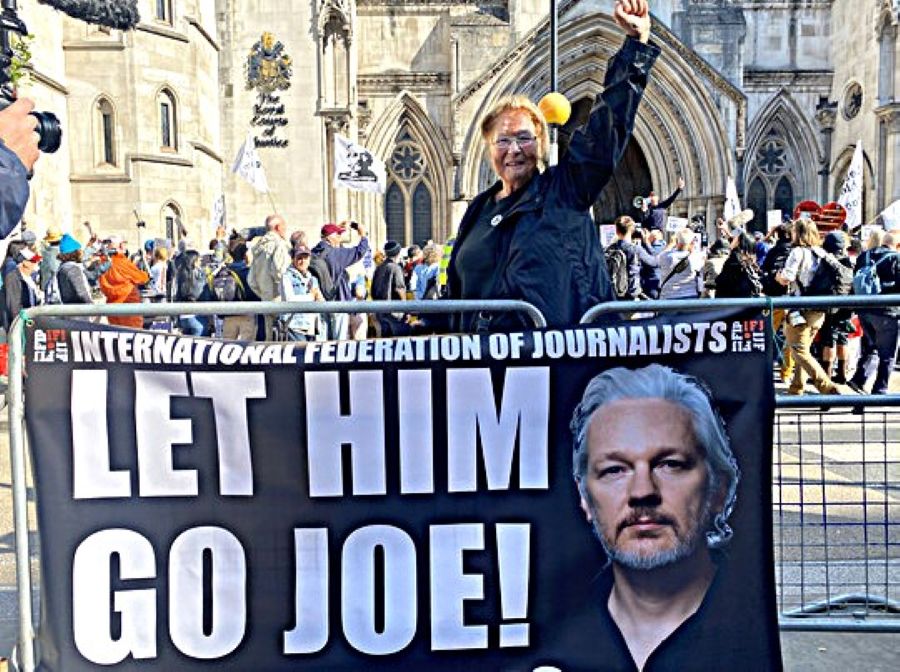
Globally, the demonstrations and support of all kinds for the defence and release of Julian Assange have been models of activism.
One of the issues that you raised during your term of office concerned the lack of international legislation to protect journalists and media professionals. The past four years have been marked by the collapse of international law, with crimes committed against journalists and media professionals going unpunished. In this context, the IFJ has advocated, and continues to advocate, for the implementation of an international convention aimed at protecting journalists and media professionals, and ending impunity. What has been the IFJ’s strategy regarding this convention and what progress has been made since 2022?
It’s not so much that international law has collapsed, but it’s rather the greed of colonial powers, coupled with the cowardice and selfishness of far too many democracies, that has undermined the implementation of international conventions, treaties and agreements.
The United Nations has, up until now, failed to resolve serious crises and ongoing wars. Its agencies – UNRWA (the United Nations Relief and Works Agency for Palestine Refugees in the Near East), the High Commissions, etc. – have come under violent attack. The International Criminal Court has been attacked as such and its members have been subjected to illegal and unjust threats and reprisals.
Against this backdrop, the IFJ’s work has, of course, suffered greatly from the chaos created and amplified by President Trump’s re-election, as well as from the scandalous impunity of the aggressor countries.
However, consciences are awakening in the face of mounting dangers and the disappearance of all humane behaviour.
Journalists, as conveyors of reliable and diverse information, are recognised as essential to any democracy worthy of the name, to any sense of togetherness in society and to any possible future.
Although the IFJ’s proposal for an international convention to protect journalists and media professionals has not yet come to fruition, an increasing number of leaders recognise its value in the short and medium terms. It is up to the Federation to succeed in uniting all these forces of goodwill.
But this isn’t enough to combat impunity, which is why we propose the establishment of an international legal framework specifically for journalists and media workers.
Its aim is to provide appropriate responses to international attacks such as journalists being spied on by various systems, such as Pegasus, Predator, Palantir, etc.; the fight against fake news spread unrestrainedly by major global platforms; and an end to the constant theft of journalists’ information by ‘Artificial Intelligence’ systems, which act as veritable colonisers.
They steal our public interest content to resell it to us at a high price after having mixed it up, mangled it and tailored it to their own liking. Journalists, as authors, hold both moral and economic rights. They must not be sidelined from the more-or-less fair deals struck between their media outlets and these giants.
A round table discussion of specialist lawyers on 4 May will identify areas for the Congress to focus on.
Across the globe, journalists and media professionals are facing deteriorating working conditions, whether due to the consequences of media concentration and State repression or financial precariousness and job insecurity in the face of artificial intelligence. How does international trade union cooperation within the IFJ play a central role in this context?
An extraordinary victory, achieved in Mauritania just a few months ago, gives us cause for optimism. 1,860 journalists have had their employment contracts regularised thanks to several years of work by the Federation, in collaboration with its affiliate.
When the IFJ is on the ground, it is heard by the country’s highest authorities and thus provides support to journalists and their representatives. While the results may not be immediate, ideas are gaining ground.
The second round table on 4 May will be organised, again with AI specialists, who will be tasked with identifying concrete areas of work for the Congress.
The IFJ not only plays a central role, but is also irreplaceable. No NGO, however well-meaning, can replace hundreds of activists!
During your four years as IFJ President, you’ve witnessed struggles, tragedies and successes in the world of journalism. Is there a particular moment that will stick in your mind forever?
A moment of indescribable joy: 3 October 2024 in Strasbourg. It was when the Council of Europe voted on the report by its Legal Affairs Committee regarding the case of Julian Assange.
The report upheld the IFJ’s position on every point. And the most important point was this: Julian Assange was recognised as a political prisoner and it was acknowledged that the UK had mistreated him legally and subjected him to inhuman and degrading treatment. Julian was there, alongside all his supporters and/or their representatives, including the IFJ! We drank champagne!
And a harrowing moment: 16 November 2024, when, via a video conference organised from the headquarters of our affiliate, the Palestinian Journalists’ Syndicate (PJS), in Ramallah, we went live with journalists in Gaza. It was an hour of poignant live coverage. Their courage, dignity and determination to continue, come what may, in their mission to inform the whole world of the ongoing genocidal war and the war crimes and crimes against humanity perpetrated by the Israeli occupation army filled us with enthusiasm and moved us to the depths of our being.
There were well over a hundred of them and we were only some 80 km away from them… How many are still alive today given that the IFJ has been reporting that more than 250 journalists have been killed in Gaza, the vast majority of whom were deliberately targeted? Legal proceedings are underway.
As you prepare to hand over to your successor, what message would you like to convey to IFJ affiliates around the world, as well as to its future leaders who will be elected in a few weeks?
It takes a great deal of courage and tenacity to defend the freedom to inform and to be informed. No issue is too small or too big, and all stakeholders are valid, provided they are honest and sufficiently informed! Make sure that you campaign for membership everywhere, too. Long live the second centenary of the International Federation of Journalists!
(Courtesy: IFJ news bulletin)