
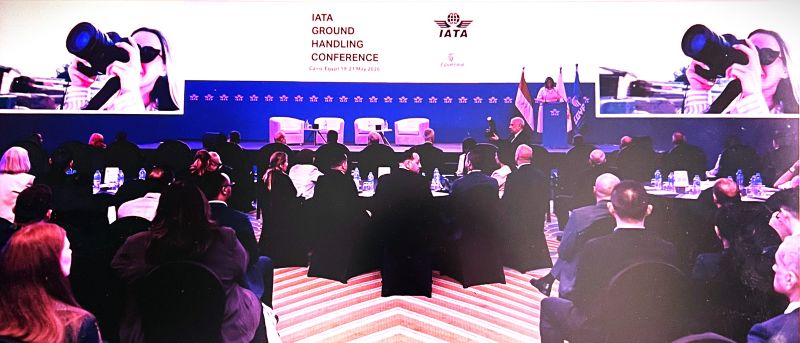
At the ongoing 38th IATA Ground Handling Conference (IGHC) in Cairo Wednesday, hosted by EgyptAir the International Air Transport Association (IATA)
called for stronger implementation of global standards, a transition to modernized ground support equipment (GSE) and greater digitalization in the ground handling sector.
This will support safer, more efficient, sustainable, and resilient ground handling. Says IATA that represents over 360 airlines accounting for some 85% of global air traffic at the May 19-21 conference.
“Ground handling is often invisible to passengers, but when it goes wrong, everyone notices. A delayed bag, a damaged aircraft, a loading error, or a disrupted turnaround may last minutes, but the consequences can ripple across an entire network,” said, IATA’s Director Ground Operations Monika Mejstrikova.
“Stronger implementation of standards, smarter equipment, and digitalization are the fundamentals that will make ground operations safer, more efficient, more sustainable, and more resilient,” added the Director.
IATA’s latest ground handling safety data shows progress, with no fatal ground handling accidents and one serious injury recorded in 2025 across nearly 40 million flights. Global standards are the foundation of safe and efficient ground operations.
For airlines and ground handling service providers (GHSPs), the key reference points are the IATA Ground Operations Manual (IGOM) and the Airport Handling Manual (AHM). IATA called on the industry to accelerate implementation, reduce unnecessary variations, and make greater use of audit programs, such as the IATA Safety Audit for Ground Operations (ISAGO), to strengthen operational discipline.
In 2025, in total, 582 organizations shared their IGOM adoption rate, and more than 500 reported alignments with AHM training requirements. IATA also highlighted Baggage, Aircraft Loading and De-icing/anti-icing issues.