
In the mid-1970s, the political landscape in Indochina shifted dramatically. The fall of Saigon, political transitions in Laos and Cambodia, and subsequent instability across the region led large numbers of people to leave their homes.
Political upheaval, conflict, persecution and economic hardship forced many families to seek refuge through the Indochinese refugee resettlement programme, searching for safety and opportunities to rebuild their lives.
ICEM’s Transformation into a Global Actor
By the late 1970s, the Indochinese refugee situation had become a defining challenge for the Intergovernmental Committee for European Migration (ICEM).
As countries around the world offered resettlement opportunities to people fleeing Southeast Asia, they turned to ICEM for support. This marked a major milestone for the organization. In stepping into this role, ICEM moved beyond its original post-war mission and emerged as a truly global migration actor.
In 1980, the organization’s name was changed to the Intergovernmental Committee for Migration (ICM), reflecting its expanding global mandate.
The Vietnamese Boat People
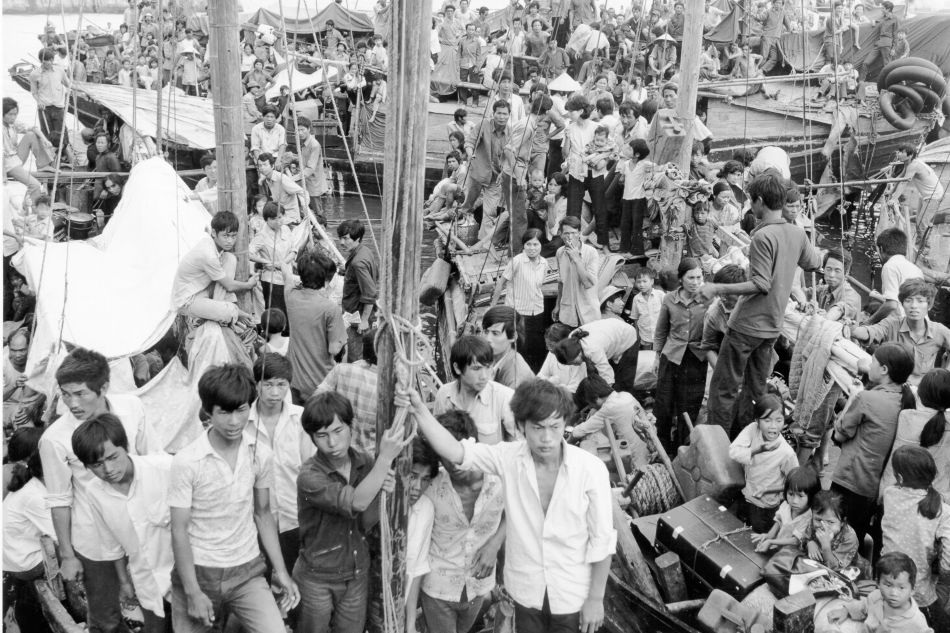
The Vietnamese “boat people”, as they were commonly referred to at the time, became one of the most widely recognized groups associated with the Indochinese refugee situation.
After the fall of Saigon in 1975, hundreds of thousands left Viet Nam in fragile, overcrowded boats, facing dangerous sea journeys in search of safety. The ICM played a central role in organizing transportation, processing, and onward-movement operations that helped refugees travel from camps and transit centres to countries willing to receive them.
Marking a Milestone in Resettlement
A ceremony commemorating the one-hundred-thousandth refugee resettled by the ICM from Thailand to the United States underscored the scale of the Indochinese refugee response.
Over the course of the operation, ICM facilitated the movement of approximately one million Indochinese refugees, marking an unprecedented expansion of its operational reach and humanitarian impact.
The milestone reflected the growing number of people seeking protection, as well as the increasing capacity of the international community to respond collectively to large-scale displacement.
Lives in Waiting
As more people crossed borders in search of safety, the crisis also became defined by the quiet, solitary moments lived by those waiting for answers. Individuals who had left everything behind faced an uncertain future, often spending weeks, months, or even years in refugee camps and transit centres across Southeast Asia.
For ICM, these moments underscored the urgency of building systems that could move people out of uncertainty and into safety. From processing documentation to coordinating travel, the organization helped establish approaches that would shape future refugee resettlement operations around the world.
Adapting to a Growing Crisis
As the situation evolved, ICM had to adapt quickly to the growing scale and complexity of refugee movements throughout the region. The organization worked with governments and international partners to support safe and orderly movements and to help manage increasing pressures on reception facilities and camps.
Its coordination helped create a more reliable refugee-processing system and strengthened rescue efforts at sea. These efforts addressed immediate humanitarian needs while also contributing to the development of large-scale refugee response strategies that continue to inform operations today.
A Humanitarian Operation on an Unprecedented Scale
Ultimately, the Indochinese refugee response pushed ICM to operate on a scale it had never attempted before. What began as an emergency response grew into a long, complex effort to help people move out of danger and toward more stable futures.
The organization’s ability to coordinate governments, aid groups, and transport networks became a lifeline for hundreds of thousands of people seeking protection. The operation transformed ICM from a largely regional organization into a global migration actor, laying the groundwork for the institution that would later become the International Organization for Migration (IOM).
(Courtesy: IOM news bulletin)