
Hundreds of journalists from across the globe have endorsed a call for the International Federation of Journalists (IFJ) to lead lobbying efforts to tackle the abuse of spyware and unlawful surveillance to defend media freedom.
According to the IFJ reports, the call, unanimously backed by delegates at the IFJ’s Congress in Paris, held from 4 to 7 May, came following the publication of a ground-breaking report on the impact of growing and abusive surveillance on sources, journalists and independent media.
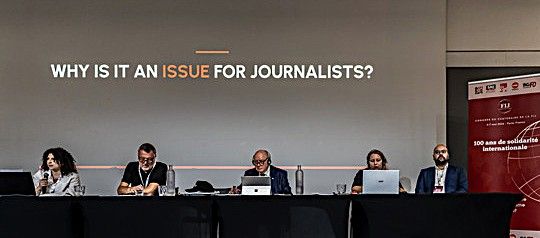
Delegates at the IFJ’s Congress heard from Samar Al Halal author of Global Surveillance of Journalists: A Technical Mapping of Tools, Tactics, and Threats – an EU-funded research study as part of the Brave Media project – who described the dangers posed to investigative journalism by unregulated and unlawful surveillance.
Al Halal told delegates that “when journalists are monitored self-censorship becomes normal…even the perception of being monitored is enough to change behaviour.”
“In more dangerous contexts, particularly in conflict zones surveillance data can contribute to increased physical risks for those seeking to hold power to account”.
She also highlighted the fact that the threat was not just a technical one but also a political one with “how technology is being used in ways that directly undermine press freedom and democratic accountability” during a panel discussion on strategies to fight surveillance, added IFJ reports.
Al Halal called for stronger laws governing defining clearly what tools can be used, in what circumstances and by whom, for sanctions for those who misuse such tools to ensure greater accountability and stricter democratic oversight of the spyware industry and government procurement processes.
She also highlighted the need to raise awareness among journalists and media organisations to ensure safety processes, risk assessments and training provide journalists with the greatest protection possible.
Seamus Dooley, representing the National Union of Journalists (NUJ) in the UK and Ireland, and Samira de Castro, of the Brazilian journalists union Federação National dos Jornalistas (FENAJ), highlighted how abuses in their regions had threatened media freedom but also how journalists’ unions, using the law and public campaigns, had been able to win justice for those unlawfully targeted and expose those seeking to undermine media freedom, writes IFJ.
Congress delegates called on the IFJ to lead a campaign to secure:
Stronger regulation of the spyware industry
Greater transparency in spyware exports and government procurement
Enhanced accountability for telecom providers
Safeguarding of rights to encryption and anonymity
Greater investment in regional forensic capacity
Enhancing safety training in journalism education
IFJ General Secretary Anthony Bellanger said, “From delegates across the world we have heard similar stories of abusive, unlawful and unregulated spying on journalists and their sources which threatens media freedom and leads to greater self-censorship and in too many cases physical threats and attacks. It is time governments, telecom companies and regulators acted to protect media freedom.”
“The IFJ gives notice that we will be working as a matter of priority to expose unlawful surveillance, provide journalists with the tools to understand the threat and protect themselves and launch global and national advocacy campaigns to demand stronger laws and regulation to protect journalists and journalism,” IFJ General Secretary Anthony Bellanger said.