

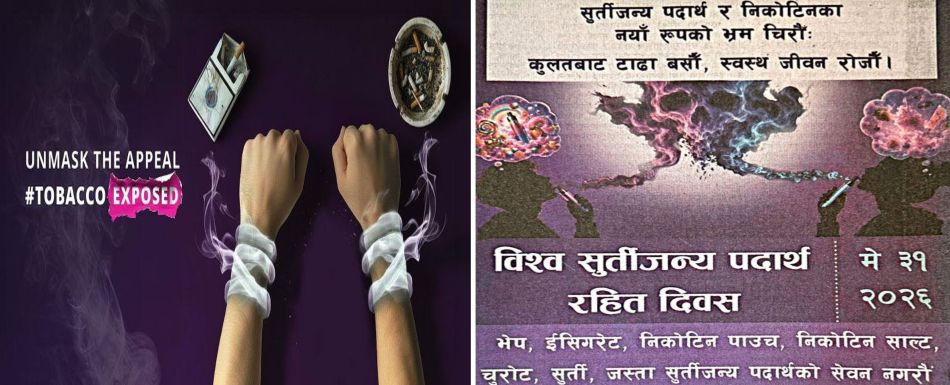
World No Tobacco Day is being observed world-wide today –31 May.
As around 40 million children aged 13–15 from around the globe use tobacco products, and young people’s use of e-cigarettes and nicotine pouches continues to rise, the World Health Organization (WHO) urges governments to protect a new generation from becoming addicted to tobacco and nicotine products.
The day is being marked by informing the public on the dangers of using tobacco, the business practices of tobacco companies and WHO’s activities on controlling tobacco use as well as what the civilians’ role is about right to health and healthy living and to protect future generations.
Tracing back to history, the member states of the WHO created World No Tobacco Day in 1987 to draw global attention to the tobacco epidemic and the preventable death and disease it causes.
In 1987, the World Health Assembly passed 7 April 1988 to be “a world no-smoking day.” But in 1988, the resolution was passed calling for the celebration of World No Tobacco Day, every year on 31 May.
WHO warns that tobacco and nicotine companies are deliberately engineering their products to make them more appealing, easier to use and harder to quit, particularly for adolescents and young people.
Nicotine is highly addictive and harmful, especially at high concentrations, particularly for children, adolescents and young adults whose brains are still developing.
Governments around the world can protect people by banning flavoured products, banning advertising, promotion and sponsorship, making indoor public places completely smoke- and vape-free and stepping up enforcement.
WHO recently warned that nicotine pouches, one of the fastest-growing nicotine products on the market, are being aggressively promoted through social media influencers, using lifestyle branding and flavours designed to appeal to young people.
The nicotine pouch report found that about 160 countries still have no specific regulations in place for nicotine pouches, despite rapidly growing sales worldwide, leaving millions of people unprotected. Bright packaging, candy-like flavours and influencer campaigns are the same tactics used for other nicotine products, with the primary goal of creating addiction to these harmful products.
WHO says, tobacco kills more than 7 million people each year, including an estimated 1.6 million non-smokers who are exposed to second-hand smoke. It remains one of the leading causes of preventable death globally and is linked to cardiovascular disease, respiratory illness and more than 20 different types or subtypes of cancer. Around 80% of the world’s 1.3 billion tobacco users live in low- and middle-income countries. Thus, it is an open secret-fact that in every country, governments’ strict rules and regulations on tobacco and nicotine could control people’s habits.
However, WHO encourages the world’s more than 1 billion tobacco, e-cigarette and nicotine pouch users to take the first step toward quitting and break free from addiction. Currently 183 member countries are parties to WHO’s treaty.
In Nepal also, the day is being celebrated with various events. Under the slogan” “End the illusion of new forms of tobacco and nicotine; Stay away from junk, choose a healthy life.”
On the occasion of World No Tobacco Day today, Minister of Health and Food Hygiene Ms. Nisha Mehta has urged people to quit smoking and use of other tobaccos from today.
Minister Mehta said “Quitting tobacco addiction may be difficult in the beginning, but it is completely possible with strong-willed families and the right advice of health workers.” Don’t be tempted by the use of any harmful substances like vape, e-cigarettes and hookah that contain harmful nicotine and toxic substances in the name of looking modern and different, she urged and informed that the ministry will provide necessary support and needy counseling for those who want to get rid of tobacco or vape addiction.

According to the latest data, about 29 percent of people in Nepal are consuming tobacco that leads to the death of more than 39,000 people in the country every year which is very sad and a matter of concern for all. That’s why the Minister strongly urged to quit immediately.
“Misleading marketing of tobacco and nicotine-containing products in different flavors, which look attractive and modern, is being done through social media, which has made the problem more serious,” she said and stressed that consumption of tobacco products should be discouraged.’
Minister Mehta said that the government has laid special emphasis on the effective implementation of laws related to control and regulation to deal with the existing challenges of tobacco products.
Anyway, all forms of tobacco use are harmful, and there is no safe level of exposure to tobacco. Cigarette smoking is the most common form of tobacco use worldwide. Around 80% of the 1.3 billion tobacco users worldwide live in low- and middle-income countries, where the burden of tobacco-related illness and death is heaviest.
Over a third of the world’s population living in 79 countries are protected by comprehensive national smoke-free laws. Today 62% of the world’s population live in the 110 countries that meet best practice for graphic health warnings, which includes among other criteria, large pictorial health warnings displayed in the national language and rotating regularly.
Though 2.9 billion people from 36 countries have aired anti-tobacco mass media campaigns, bold steps must be taken to ban tobacco advertising with introduction of effective taxes and stop the illicit trade of tobacco products.