
Fairer representation must: General Assembly President, World needs stronger UN: Secretary General
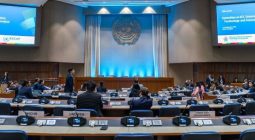
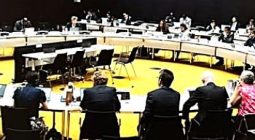
World’s largest diplomatic conclave is still ongoing in New York. Thousands of delegates from around the world are meeting at the United Nations Building Halls. A podium desk holds laptops, monitors, a microphone, and seating chart.
Though many world leaders including the US President Donald J. Trump to French President Emanuel Macron, Brazil President Luiz Inácio Lula da Silva and and more other world leaders had already addressed to the 81st Session of the United Nations General Assembly in New York on September 22 and onwards.
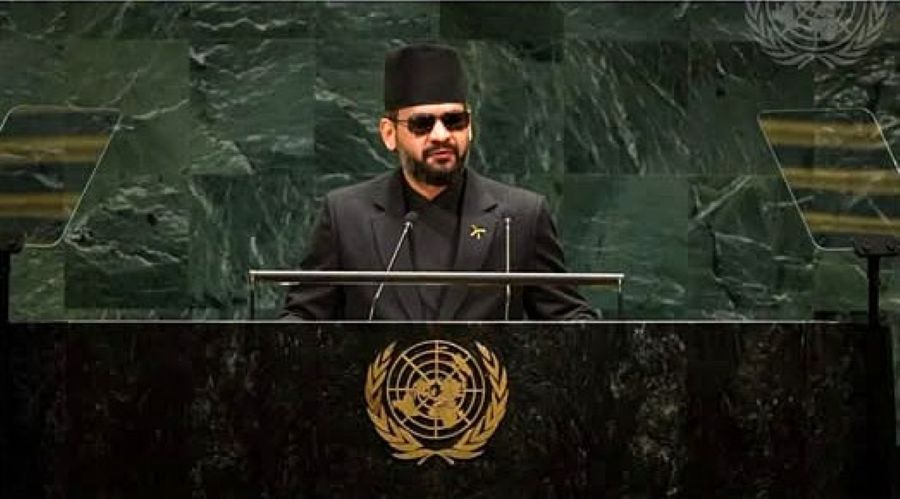
Nepalese Prime Minister Balendra Shah had also addressed to the 81st UNGA General Debate Session on the evening of September 24, 2026 US Eastern Time which is an early morning of September 25 Nepal Time.
In course of address to the 81st UNGA, Prime Minister Balendra Shah has said, “I come before you from Nepal – a distant country in the Himalayas – carrying a close warning for humanity. And about a country whose steady progress to achieve Sustainable Development Goals has been interrupted.
Four weeks ago, the world saw the shocking images of the catastrophic flash floods that swept through Nepal’s mountain communities with ferocity many have called a “Himalayan Tsunami.”
Nearly three years ago, standing in the shadow of our Mount Everest, the Secretary-General of the United Nations warned humanity about the madness of an impending climate disaster.
Climate change does not recognize borders. Glaciers and floods do not travel with a visa stamped on passports, PM Shah stressed.
I wish to express Nepal’s deep gratitude to all those who came to our aid in the aftermath of the deluge.
Nepal contributes less than 0.1 percent of global greenhouse-gas emissions. But we are paying a colossal price for it.
The Hindu Kush Himalaya is home to nearly two billion people. These mountains provide water, ecosystems, agriculture and livelihoods to populations far beyond Nepal.
That is why, as an urgent first step, we propose that we establish a Himalayan Climate Resilience Mechanism, led by Nepal, India and China. Let the Himalayas become a laboratory of international cooperation, rather than a frontier of fragmented information.
We need adequate grant-based support from the world. The Loss and Damage Fund, the Global Environment Facility and other relevant financing mechanisms remain grossly inadequate.
The United Nations was born from humanity’s experience of horrific World Wars. Its promise was that sovereignty would matter. International law would matter. The dignity of every human being would matter. And the weak would not simply have to accept whatever the powerful decide.
Today, that international system is under strain. Too often, military and economic power determines whose voice is heard. Nepal believes we need a much fairer global economic order, he louds.
The new majority government in Nepal, elected through the fairest and most peaceful elections in our history this March, has had to weather many international adversities since.
We have built a world with flawless logistics for war and broken logistics for food. And this is not Nepal’s private misfortune. Ask Bangladesh. Ask Bhutan. Ask India. Ask the Maldives. Ask Pakistan. Ask Sri Lanka. Ask any other country in our region and you will hear the same account: hit by the climate we did not warm, and hit again by the wars we did not start.
I am told I am the youngest Head of Government to address this Assembly this year. I did not come here to make that the story. I came to make sure that whatever else is said from this podium, one thing is said plainly: a country that is willing to pay should be able to buy, and a world that can deliver a weapon anywhere in seventy-two hours has no excuse for leaving a farmer without means for a decent livelihood. This is why we continue to believe in multilateralism. This is why we need a United Nations in which the presence of small poor countries is felt, and we can work together towards just outcomes.
Climate justice is, therefore, not only about money. It is about distributive justice – who bears the costs. It is about procedural justice – who has a voice. It is about whether the future of mountain communities, small island states, landlocked and least-developed countries, and generations yet unborn count equally.
Starting tomorrow at the “Sagarmatha to the Sea” side-event right here at the United Nations, Nepal is ready to help lead this conversation.
The Nepal floods signal a future shaped by rising climate extremes. Our baselines are no longer relevant. And we must move from ad-hoc responses to a culture of preparedness. Let us be ready to hear it, and ready to act, PM said.
भगवान पशुपतिनाथले विश्वको कल्याण गरुन्। यो विश्व बुद्धले देखाएको बाटोमा हिंड्न सकोस्।
धन्यवाद, नमस्ते।
(May Lord Pashupatinath bring about the welfare of the world. May the world be able to walk the path shown by the Buddha. Thank you, Namaste.)
With these Nepali words PM Shah concludes his speech at the UNGA.
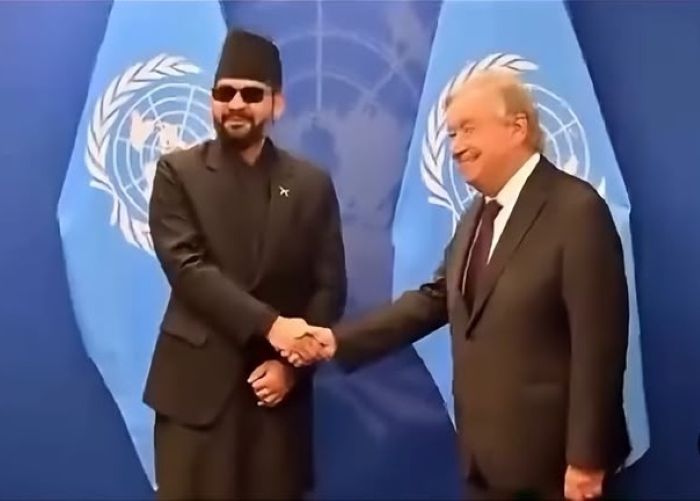
Earlier on September 22, 2026 opening the 81st UN General Assembly in New York on Tuesday, UN General Assembly’s 81st session President Khalilur Rahman has said that, the UN’s survival for 80 years is not, by itself, proof of success, and now, the institution must confront painful truths if it hopes to rebuild public trust.
The UN has grown from 50 Member States in 1945 to 193 today, but survival alone is not evidence of success, he stressed.
Global military spending has climbed toward US $3 trillion while development assistance fell 23 per cent year-on-year even as progress has stalled for a third of the 17 Sustainable Development Goals (SDGs) targets.
“When the Security Council works, the United Nations works,” Mr. Rahman said and stressed on fairer representation adding Africa needs a seat at the table, not to be on the menu.”
Acknowledging the UN’s failures – including the unresolved Palestinian question and ongoing wars in Sudan, Gaza, Ukraine, Myanmar and across the Middle East – Mr. Rahman balanced this with lesser-known successes.
Earlier in his welcome speech, UN Secretary-General António Guterres call for Security Council reform, highlighting the continued “indefensible” absence of permanent African representation
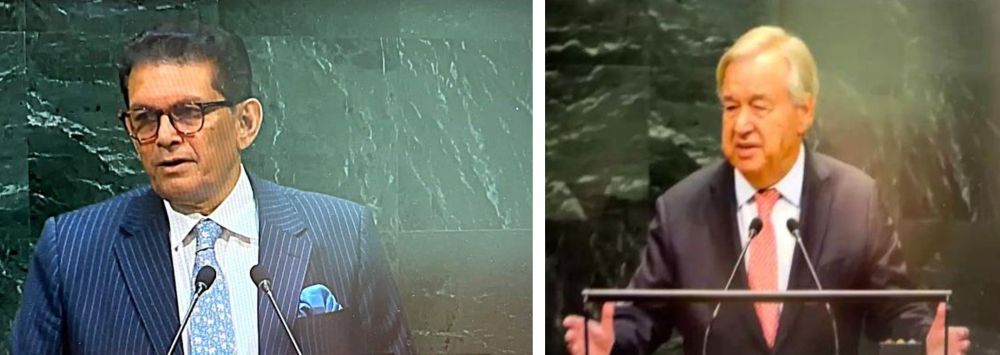
With roughly 100 days remaining in his term as UN Secretary-General, António Guterres delivered a wide-ranging speech that framed the world’s most pressing crises not as isolated problems, but as different expressions of the same underlying struggle over how power is exercised and by whom.
He also condemned Russia’s full-scale invasion of Ukraine as a clear violation of the UN Charter.
Highlighting the gap between record global wealth and the billions still lacking access to food, clean water, education and healthcare, he said inequality is not merely an economic issue but a question of power over opportunity, resources and self-determination.
Devoting particular attention to gender inequality, he announced that the UN has achieved full gender parity across senior leadership, headquarters staff, and professional roles for the first time in its history.
“Equality is not a dream; it is a decision,” he said, citing progress at the UN as proof that entrenched power structures can change.
“The world does not need a weaker United Nations but needs a UN strong enough to face the world as it is and determined enough to build the world as it should be,” the Secretary General stressed.
The world leaders’ address to the UNGA is being continued till September 28. So, more leaders form around the world are on queue to address.
Meanwhile, in another report, during the sideline meetings at the UNGA session, the UN Declaration on Sea Level Rise was approved.
The global mean sea level is on the rise around the world and accelerating, according to the UN Intergovernmental Panel on Climate Change that has affected nearly 770 million people who live in coastal areas.
According to a UN report presented at the UN Pacific Islands Forum in Palau, sea levels are rising faster than ever and represent “one of the most profound threats to populations around the world.” Just a half-meter rise in sea levels by the end of the century could force between 150 million and 300 million people from their homes.
Some small island States are already planning to be swallowed by the sea, with Tuvalu transitioning to become the world’s first “digital nation”. Nations contributing least to such climate change consequences as sea level rise are facing the worst impact.