
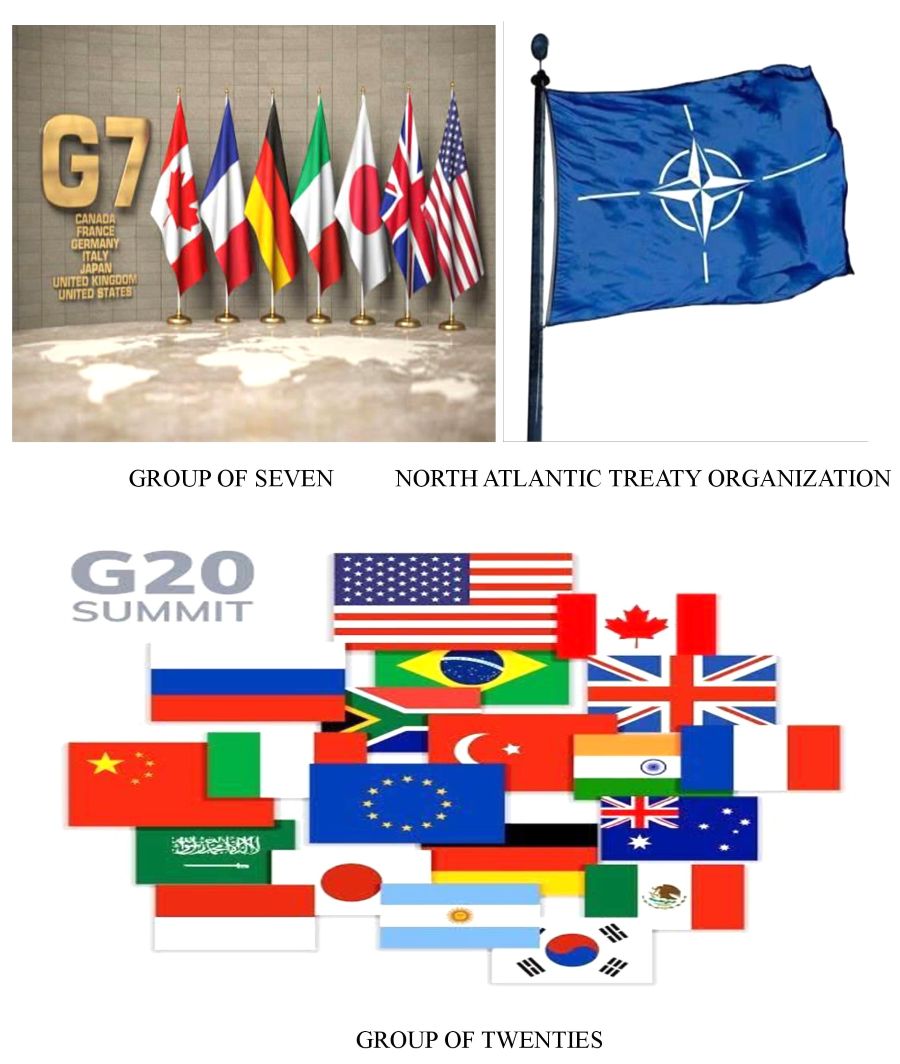
GROUP OF SEVEN
The Group of Seven (G-7) is a global organization that meets to discuss economic and financial issues. Its members are France, Germany, Italy, Japan, the United States, the United Kingdom, and Canada. Government leaders of these countries meet periodically to address international economic and monetary issues, with each member taking over the presidency on a rotating basis.
The G-7 was, for a while, known as the Group of Eight (G-8), until 2014, when former member Russia was removed after annexing the region of Crimea illegally from Ukraine.
The European Union (EU) is sometimes considered to be a de facto eighth member of the G-7 since it holds all the rights and responsibilities of full members except to chair or host meetings.
The G-7 is non-legislative in nature, meaning it is not a governing body and cannot create or enforce any laws in member countries. However, the body creates initiatives for global issues that its members agree to abide by or strive for.
The main goal of the G-7 is to address global issues, especially economic ones, and sometimes act together to solve them. Since its inception in the early 1970s, the group has discussed financial crises, monetary systems, and major world crises, such as oil shortages.
The G-7 began in the early 1970s when leaders from the U.S., U.K., France, West Germany, and Japan met in Paris to talk about the occurring recession and oil crisis. That, in turn, inspired French President Valéry Giscard d’Estaing to invite the leaders of those countries, plus Italy, to Rambouillet in 1975 for further discussions on global oil, this time with the country’s leaders joining the finance ministers—an attendance roster that has endured. The next year, Canada was invited to join the group.
The G7 presidency rotates each year among these countries: France, U.S., U.K., Germany, Japan, Italy, and Canada
“Group of 7” (or G7) primarily refers to an elite group of seven large advanced economies—Canada, France, Germany, Italy, Japan, the UK, and the USA—that meet to discuss global economic issues.
The Group of Seven (G7) does not have a permanent headquarters, legal existence, or fixed secretariat.
Rotating Presidency: The leadership rotates each year among the member countries (Canada, France, Germany, Italy, Japan, the United Kingdom, and the United States).
GROUP OF TWENTIES
The G20 (Group of 20) is a major international forum. It brings together the world’s leading industrial and emerging market economies to coordinate global policy on trade, stability, and sustainable development. It represents about 85% of global economic output and two-thirds of the world’s people.
Group of Twenty. It is a major international group for the global economy and financial cooperation.
Unlike some other international organizations, the G-20 does not have a permanent secretariat or headquarters. G-20 summits are hosted by member countries on a rotating basis, and the host nation typically provides the necessary support services.
The G20 was established in 1999 in the wake of the late-1990s Asian financial crisis
Argentina, Australia, Brazil, Canada, China, France, Germany, India, Indonesia, Italy, Japan, Mexico, Russia, Saudi Arabia, South Africa, South Korea, Turkey, the United Kingdom, and the United States are the members.
The European Union and the African Union are the regional bodies that represent it as a member.
The G20, or Group of Twenty, is an international forum that brings together the world’s major advanced and emerging economies to discuss and coordinate economic policy. Its participants represent about 85% of global GDP and two-thirds of the world’s population.
The primary purpose of the G20 (Group of Twenty) is to coordinate international economic policy, promote global financial stability, and foster sustainable growth. It unites major advanced and developing economies—representing 85% of global GDP and two-thirds of the world’s population—to solve major economic and systemic challenges
NORTH ATLANTIC TREATY ORGANIZATION
The North Atlantic Treaty Organization (NATO) is a political and military alliance founded in 1949 by 12 North American and European nations. It currently comprises 32 member countries. Its core rule is collective defense (Article 5), meaning an attack on one member is an attack on all
Formed in 1949 with the signing of the Washington Treaty, NATO is a security alliance of 32 countries from North America and Europe. NATO’s fundamental goal is to safeguard the Allies’ freedom and security by political and military means.
The main purpose of the North Atlantic Treaty Organization (NATO) is to guarantee the freedom and security of its member countries through political and military means. It acts as a collective defense system where an armed attack against one member is treated as an attack against all.
NATO was founded on April 4, 1949, when 12 countries from North America and Europe signed the North Atlantic Treaty in Washington, D.C.
Founding Member Countries are Belgium, Canada, Denmark, France, Iceland, Italy, Luxembourg, Netherlands, Norway, Portugal, United Kingdom, United States
Albania, Belgium, Bulgaria, Canada, Croatia, Czech Republic, Denmark, Estonia, Finland, France, Germany, Greece, Hungary, Iceland, Italy, Latvia, Lithuania, Luxembourg, Montenegro, Netherlands, North Macedonia, Norway, Poland, Portugal, Romania, Slovakia, Slovenia, Spain, Sweden, Turkey, United Kingdom, United States are the members of the NATO.
The United States is by far the strongest country in NATO. It provides the largest share of defense spending, nuclear capabilities, advanced military technology, and active military personnel in the entire 32-member alliance.
The headquarters of NATO is located on Boulevard Léopold III in Haren, part of the City of Brussels, Belgium.
To be continued………….