
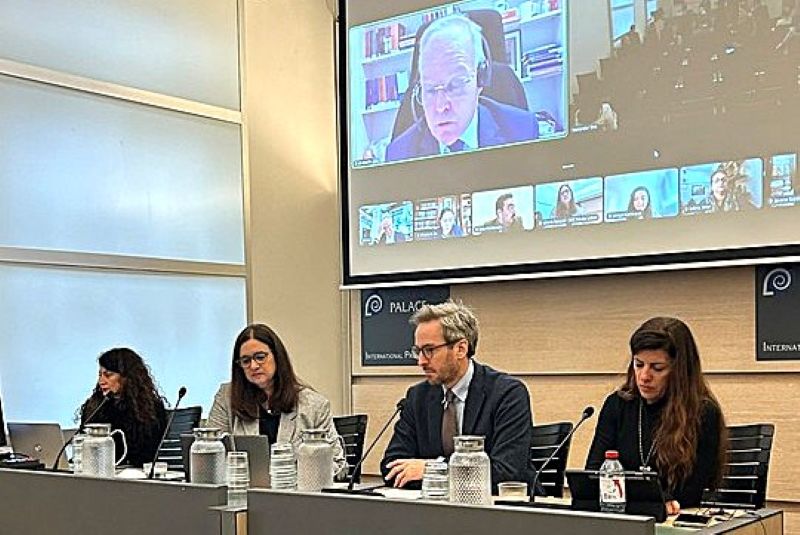
A forum, entitled ‘Hacked silence: Journalists under surveillance’ was organized by the International Federation of Journalists (IFJ) in Brussels, Belgium on 19 November.
Institutional and political representatives, journalists, experts and civil society actors agreed that it is time to act to protect journalists, their sources and the public’s right to information, IFJ release stated.
“There is an urgent need for mechanisms to assist journalists on the technical and legal side when they are targeted by surveillance tools,” stated Leopoldo Gutiérrez, the UN Special Rapporteur on Freedom of Opinion and Expression. Institutional and political representatives, journalists, experts and civil society actors agreed to this demand.
Renaud de Villaine, from the Office of the United Nations High Commissioner for Human Rights (OHCHR), called for a moratorium on the export, transfer and use of surveillance technologies until adequate safeguards are in place.
Ambassador Jan Braathu, OSCE Representative on Freedom of the Media, underlined that for societies to be safe and secure, journalists must be able to investigate, report, and question those in power without fearing that their sources, communications or private lives would be exposed, the release added.
During the event, Thanasis Koukakis, a Greek journalist whose phone was infected with Predator spyware in 2021, questioned the state’s use of national security to justify political motivations, including the surveillance of journalists.
At the time, the surveillance of Koukakis was the first publicly confirmed case of a journalist in Europe being spied on using Predator. He has taken his case against Greece to the European Court of Human Rights (ECHR), it said.
Salma Abdalla, head of Al Jazeera’s media relations department, also shared information about the attacks that the Al Jazeera newsroom was subjected to in 2024 and 2025.
In collaboration with its cybersecurity team, additional measures were implemented to safeguard journalists, including the installation of ad blockers, regular security checks and journalist training.
“As an international media organisation, our mandate is to educate the public, because what threatens journalists also threatens the public,” Abdalla said.
Elsy Moufarrej, President of the Union of Journalists in Lebanon, described the deadly costs that surveillance could have on journalists, such as the targeting and killing of Lebanese journalist, Amal Khalil, by the Israeli army, the release reads.
Moufarrej recalled the deadly consequences that the surveillance of journalists has in the region, particularly in Palestine and Lebanon. “Surveillance is used not only to collect information, but also to intimidate and target journalists. This underscores the urgent need to fight impunity”.
The forum concluded with two calls to action: one campaigning for stronger regulation of the surveillance industry to protect journalists, and the other encouraging media organisations and journalists’ unions and associations to better educate journalists on how to protect themselves.
The IFJ was pleased to see a general agreement among the participating organisations to collaborate and explore the creation of an independent, international mechanism to protect journalists and their sources of information from surveillance, it added.

Over the next few weeks, the IFJ will hold consultation meetings with relevant experts, institutional and political representatives, journalists, and civil society actors to make progress in this area.
Building on two reports commissioned by the federation as part of the Brave Media project, ‘Global Surveillance of Journalists: A Technical Mapping of Tools, Tactics and Threats’ and ‘Hacked Silence: Journalists and surveillance – Addressing legal and regulatory challenges’, the IFJ has developed a policy paper to strengthen protections for journalists in the face of surveillance. It calls for stronger controls on the sale and export of spyware and urges the international system to be ready to monitor surveillance abuses.
The policy paper has already been endorsed by a number of unions and organisations from across the world.
IFJ President Zuliana Lainez emphasised the responsibility of governments, employers and technology companies in the surveillance of journalists. “We cannot expect journalists to deal with this kind of threat alone. More often than not, they are not even aware that they are being surveilled. Journalists should be able to investigate, speak to their sources and carry out their work without fearing that they are being watched. Protecting our sources is essential for journalists. If we cannot do that, we cannot properly inform the public.”
IFJ General Secretary Anthony Bellanger concluded that the surveillance of journalists must no longer be considered inevitable. He called for stronger rules for companies that sell these technologies as well as more protection for journalists and their sources.
“I would like to thank all speakers and participants who contributed to the discussion and announce that the IFJ would continue the conversation worldwide with upcoming regional meetings to be held in the Middle East and the Arab region, Latin America and the Caribbean and Asia-Pacific, among others. In parallel, the IFJ will hold consultation meetings with relevant experts and media organisations to explore the creation of an independent, international mechanism to protect journalists from surveillance”.
This forum was organised as part of the IFJ contribution to the Brave Media project, a global consortium of nine organisations led by BBC Media Action and co-funded by the European Union, release noted.