
African Union
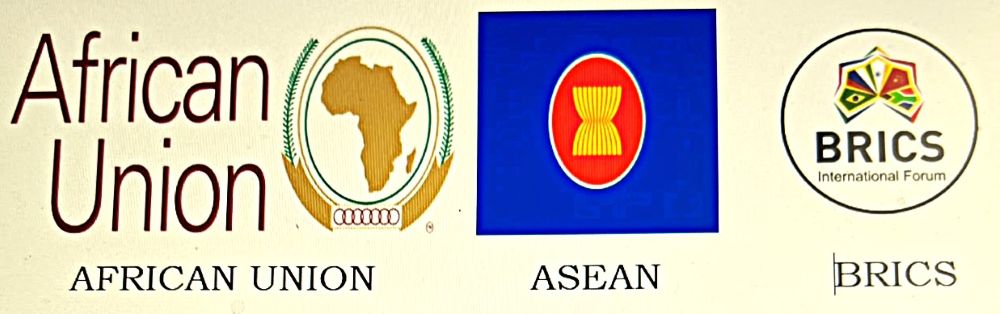
The African Union is a continental union of 55 member states located on the continent of Africa. The AU was announced in the Sirte Declaration in Sirte, Libya, on 9 September 1999, calling for the establishment of the African Union. The bloc was launched on 9 July 2002 in Durban, South Africa.
The objectives of the African Union are: To achieve greater unity, cohesion and solidarity among the African countries and African nations. To defend the sovereignty, territorial integrity and independence of its Member States. To accelerate the political and social-economic integration of the continent.
Algeria, Benin, Burundi, Cameroon, Central African Republic, Chad, Congo-Brazzaville, Democratic Republic of the Congo (now Benin), Egypt, Ethiopia, Gabon, Ghana, Guinea, Ivory Coast, Liberia, Libya, Madagascar, Mali, Mauritania, Morocco, Niger, Nigeria, Rwanda, Senegal, Sierra Leone, Somalia, Sudan, Tanganyika (now part of Tanzania), Togo, Tunisia, Uganda, Upper Volta (now Burkina Faso) are the founding members of African Union.
The African Union Headquarters is in Addis Ababa, Ethiopia which serves as the political and administrative center for the entire member states of the African Union. The member states are: Algeria, Angola, Benin, Botswana, Burkina Faso, Burundi, Cabo Verde, Cameroon, Central African Republic, Chad, Comoros, Congo (Republic of the), Côte d’Ivoire, Democratic Republic of the Congo, Djibouti, Egypt, Equatorial Guinea, Eritrea, Eswatini, Ethiopia, Gabon, Gambia, Ghana, Guinea, Guinea-Bissau, Kenya, Lesotho, Liberia, Libya, Madagascar, Malawi, Mali, Mauritania, Mauritius, Morocco, Mozambique, Namibia, Niger, Nigeria, Rwanda, Sahrawi Arab Democratic Republic, São Tomé and Príncipe, Senegal, Seychelles, Sierra Leone, Somalia, South Africa, South Sudan, Sudan, Tanzania, Togo, Tunisia, Uganda, Zambia, Zimbabwe.
ASEAN
The Association of Southeast Asian Nations (ASEAN) is a regional intergovernmental organization founded on August 8, 1967, in Bangkok, Thailand, with the motto of “One Vision, One Identity, One Community” to boost economic growth, social progress, and regional peace.
Indonesia, Malaysia, Philippines, Singapore and Thailand are the founding members of ASEAN.
Brunei, Cambodia, Indonesia, Laos, Malaysia, Myanmar, the Philippines, Singapore, Thailand, Timor-Leste and Vietnam are the members of the ASEAN.
The headquarters is in Jakarta, Indonesia.
ASEAN countries have a total population of 678 million people—making it the third most populous region in the world—and a combined gross domestic product (GDP) of $3.9 trillion. The group has played a central role in Asian economic integration, joining negotiations to form the world’s largest free trade agreement and signing six free trade deals with other governments in the region.
BRICS
Founded by Brazil, Russia, India, and China at their first official summit in 2009 BRIC is an intergovernmental organization of major emerging economies and developing countries, originally coined as an acronym (BRIC) by Goldman Sachs in 2001.
But in 2011 it formally expanded with the admission of South Africa and has changed from BRIC to BRICS (Brazil, Russia, India, China, South Africa) with motto of Building for Resilience, Innovation, Cooperation and Sustainability.
BRICS headquarter is located in Shanghai, China whose leaders’ meet every year in a summit.
However, admitting more economically advancing countries, it currently comprises full members of Brazil, China, Egypt, Ethiopia, India, Indonesia, Iran, Russia, Saudi Arabia, South Africa, and the United Arab Emirates.
Belarus, Bolivia, Cuba, Kazakhstan, Malaysia, Nigeria, Thailand, Uganda, Uzbekistan and Vietnam are the BRICS Partner countries.
The primary purpose of BRICS is to enhance economic, political, and cultural cooperation among emerging market economies. It acts as a counterweight to Western-dominated global institutions, aiming to reform global governance and amplify the voice of the Global South.
The BRICS agenda has expanded considerably from its initial focus on economic issues of mutual concern and is structured around three core pillars: Political and Security, Economy and Finance, Cultural and People to People Exchanges.
BRICS cooperation continues to broaden its scope across a wide range of global issues, including fight against terrorism, climate change, food and energy security, the international economic and financial situation, telecommunications, agriculture, labour and employment, international financial architecture, trade, and the WTO.
To be continued………..