
International journalists and media professionals have called for greater accuracy, fairness, and responsibility in journalism as part of efforts to promote peace and strengthen social cohesion across the world, writes Winston Mwale.
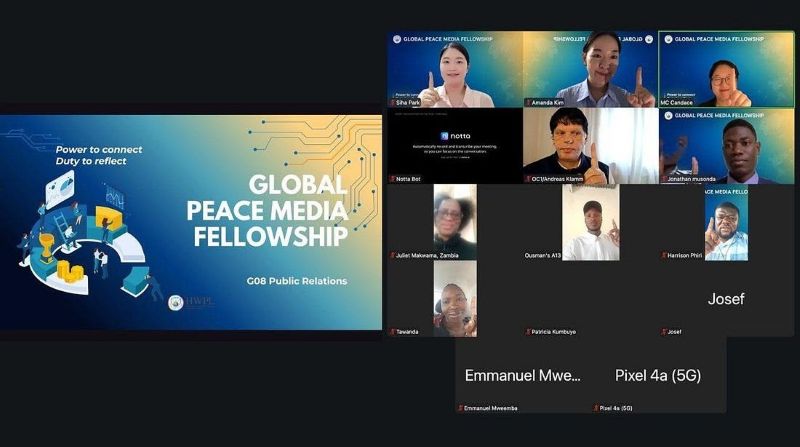
The calls were made during the inaugural Global Peace Media Fellowship hosted online the other day by Heavenly Culture, World Peace, Restoration of Light (HWPL).
Held under the theme “Power to Connect, Duty to Reflect,” the fellowship brought together journalists from different countries to discuss the social responsibility of the media and its role in peacebuilding amid growing global social and political challenges.
According to HWPL, the fellowship was designed to provide a platform for journalists and media practitioners to share reporting experiences, discuss major social issues affecting their countries, and explore how journalism can contribute to peace and public understanding.
In his congratulatory remarks, Belgian publisher Andy Vermaut stressed the power and responsibility of journalism in shaping societies.
“A single piece of false information can spark unrest, while a single honest report can help prevent war,” said Vermaut.
He described journalism as “not only a mirror reflecting reality, but also a map guiding the way forward.”
During the fellowship, journalists from Germany, Zambia, Malawi, and other countries highlighted issues currently dominating media coverage in their respective nations, including elections, economic challenges, and climate change.
Participants exchanged views on how media coverage influences public understanding and agreed that balanced reporting and verified information are particularly important when covering elections and other sensitive national issues.
The fellowship also featured a session where participants shared stories demonstrating journalism’s potential to drive social change.
Malawian journalist Ousman Kaliati of Times Group presented his article, “When Hope Hangs by a Thread,” which examines rising suicide cases linked to economic hardship and highlights the struggles faced by vulnerable communities.
Meanwhile, Joseph Phiri of the Zambia National Broadcasting Corporation (ZNBC) shared his experiences reporting on disability rights, noting that journalism can serve as a bridge between marginalized communities and policymakers.
He said his reporting had contributed to raising public awareness and encouraging institutional responses to disability-related challenges.
Another participant, Juliet Makwama of Impact Stories Zambia, reflected on her engagement with the Media Association for Global Peace (MAGP), describing it as an opportunity to rethink the role of journalism beyond politics.
She said journalists should also focus on stories that create meaningful impact within local communities and among vulnerable groups.
In closing reflections, German journalist Andreas Klamm emphasized the importance of remaining committed to truth and fostering dialogue.
“Journalists should share accurate information and help people gain access to understanding, dialogue, peace, and justice,” he said.
Klamm added that the media can act as a bridge connecting people and contribute to building a better future.
An HWPL representative said the organization plans to continue hosting the fellowship as a platform for strengthening international media networks and promoting a culture of peace through journalism.
HWPL is an international peace organization dedicated to advancing world peace through initiatives such as peace education, interfaith dialogue, advocacy for international peace law, and the development of youth, women’s, and media networks.
(Based on Winston Mwale’s report in Africa Brief)